
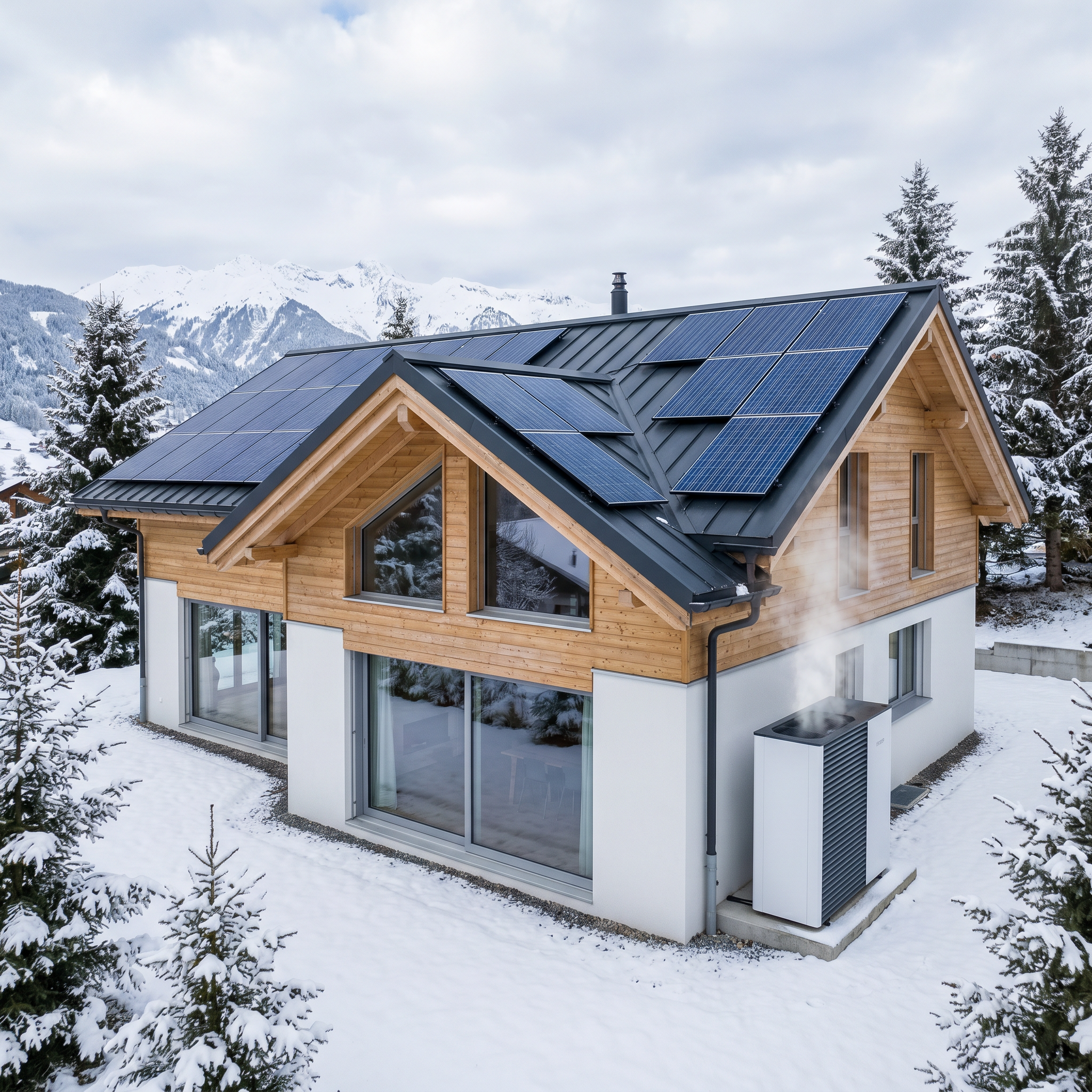
Why is the solar panel and heat pump combination so efficient?
A heat pump is one of the most efficient heating systems — it produces 3–5 kWh of heat from 1 kWh of electricity. Grid electricity in Switzerland costs 28–35 cents per kWh. Solar panels produce electricity for only 8–12 cents per kWh over their lifetime.
Running your heat pump on solar electricity drastically reduces effective heating costs. That is the core of the combination — and why more and more Swiss homeowners are adopting this system.
The Seasonal Coefficient of Performance (SCOP) determines how efficient the combination is. The higher the SCOP, the less electricity the pump needs:
- Air-to-water heat pump: SCOP 3.0–3.5 → 4,300–5,000 kWh/year for 15,000 kWh of heat
- Ground-source heat pump (geothermal): SCOP 4.0–4.5 → 3,300–3,750 kWh/year
- Water-source heat pump: SCOP 4.5–5.5 → 2,700–3,300 kWh/year
A heat pump produces 3–5 kWh of heat from 1 kWh of electricity. Solar electricity costs only 8–12 ct./kWh over its lifetime — vs. 28–35 ct./kWh from the grid.
Solar panels and heat pump combination — what does it cost in Switzerland?
The combination is a larger investment than solar panels alone. Here are the reference values for a typical single-family home:
- Solar panels 10–15 kWp: CHF 18,000–28,000
- Air-to-water heat pump: CHF 18,000–30,000
- Ground-source heat pump: CHF 35,000–55,000
- Battery storage 10 kWh (optional): CHF 7,000–10,000
- Energy management system: CHF 1,500–3,000
- Full package without battery: CHF 36,000–58,000
- Full package with battery: CHF 43,000–68,000
After deducting all subsidies, the net investment is reduced to CHF 25,000–40,000 — for a system lifetime of 20–30 years.
What subsidies are available for the combination in Switzerland?
Solar panels and heat pumps are subsidized separately in Switzerland — meaning you receive support for both components.
For solar panels: the federal one-time payment (OTP) is approx. CHF 3,550–5,450 for 10–15 kWp. Plus tax deduction as property maintenance (until end of 2027): savings of CHF 4,000–8,000.
For the heat pump: the federal Buildings Programme offers CHF 3,000–10,000. Cantonal contributions are CHF 1,000–5,000 depending on the canton. Many energy providers offer additional contributions and reduced heat pump tariffs (up to 30% discount).
- Federal one-time payment (OTP) for solar: CHF 3,550–5,450
- Tax deduction for solar (until end of 2027): savings CHF 4,000–8,000
- Federal Buildings Programme for heat pump: CHF 3,000–10,000
- Cantonal contributions for heat pump: CHF 1,000–5,000
- Energy provider contributions: CHF 500–2,000
Total possible subsidies: CHF 8,000–20,000. The tax deduction expires at the end of 2027 — 2026 and 2027 are the last years to take full advantage.
How much can I actually save? Calculation example
Take a typical Swiss single-family home currently heated with oil: 2,000 litres/year consumption (approx. CHF 2,400/year), household electricity costs approx. CHF 1,500/year.
After installing solar panels (12 kWp) and an air-to-water heat pump: heating costs drop from CHF 2,400 to CHF 400/year (savings CHF 2,000). Electricity costs drop from CHF 1,500 to CHF 300/year (savings CHF 1,200).
- Total annual savings: CHF 3,200/year
- Net investment after subsidies: approx. CHF 30,000
- Payback period: approx. 9–10 years
- Return on investment over lifetime: 8–12% p.a.
- System lifetime: 20–25 years
With a net investment of CHF 30,000, the payback period is approx. 9–10 years — with a return of 8–12% p.a. over 20–25 years.
Solar panels and heat pump — which type is best?
Not all heat pumps combine equally well with solar panels.
Air-to-water heat pump (most common choice): Cheapest installation, no drilling required. SCOP 3.0–3.5, uses more solar electricity. Ideal for existing buildings and smaller budgets.
Ground-source heat pump / geothermal (most efficient): Highest SCOP 4.0–4.5, uses less electricity, but more expensive due to drilling (CHF 15,000–25,000). Drilling depth 150–300 m, ground probe lifetime over 50 years. Ideal for new builds and maximum efficiency.
Water-source heat pump (most powerful): SCOP 4.5–5.5, requires sufficient groundwater availability. Not possible everywhere, permit required.
For most Swiss single-family homes, the air-to-water heat pump combined with solar panels is the most practical and economical solution.
What size solar panels do I need for a heat pump?
An air-to-water heat pump for a typical single-family home requires approx. 4,000–5,000 kWh of electricity per year for heating and hot water. Add the regular household electricity consumption of 4,000–5,000 kWh/year — total approx. 8,000–10,000 kWh/year.
A 10–12 kWp solar system produces approx. 9,000–11,000 kWh/year in Switzerland — a perfect match.
- Air-to-water HP + household: 10–13 kWp solar panels recommended
- Ground-source HP + household: 8–10 kWp (more efficient HP needs less electricity)
- With electric car in addition: +3–5 kWp
Rule of thumb: air-to-water heat pump + household = 10–13 kWp. With a ground-source heat pump, 8–10 kWp is sufficient.
Do I need a battery storage system?
Not necessarily — but a battery significantly increases self-consumption.
Without battery: In summer, the heat pump runs directly on solar electricity for hot water. In winter — when the heat pump uses most electricity — solar production is low. Self-consumption rate: approx. 40–50%.
With battery: Solar electricity from midday is stored and used in the evening for the heat pump. Self-consumption rate: approx. 60–75%.
With battery + smart heating control: The heat pump pre-heats the hot water tank during the day using solar energy. Self-consumption rate: up to 80–90%.
An energy management system that automatically activates the heat pump when solar surplus is available is often more cost-effective than an expensive battery.
Who benefits most from the combination?
Homeowners with old oil or gas heating: Switching from oil/gas to heat pump + solar reduces energy costs the most. The combination of subsidies is maximum here.
New builds and full renovations: Integration is optimally planned from the start. Underfloor heating and a well-insulated building envelope maximize heat pump efficiency.
Households with electric vehicles: Anyone with or planning an EV already needs more electricity. The solar system must be dimensioned accordingly — and the combination pays off even more.
- Old oil/gas heating: maximum savings and combined subsidies
- New constructions: optimal integration from the start
- Electric vehicle owners: larger installation, even more savings
- Investing in 2026/2027: tax deduction for both systems before 2027 expiry
By investing in 2026 or 2027, you can deduct the total costs of both systems from your taxes — saving an additional CHF 4,000–10,000.
Step by step: how to proceed
Step 1 — Analyse energy needs: How much electricity does your household use? How much heat does your building need? Is it well insulated? A certified installer answers these questions in a free consultation.
Step 2 — Size the system: Solar panels and heat pump must be matched to each other. A system that is too small will not cover the heat pump's electricity needs.
Step 3 — Compare quotes: Getting at least 3 quotes is essential for such a large investment. Price differences between installers can be CHF 5,000–10,000.
Step 4 — Apply for subsidies: For the Buildings Programme (heat pump), the application must be submitted before work begins. For the OTP (solar panels), the installer submits the application after installation.
Step 5 — Installation and commissioning: Solar panels and heat pump can be installed simultaneously or in stages. Simultaneous installation saves scaffolding costs.
Request solar panel + heat pump combination now
Combine solar panels with a heat pump and save up to 70% on heating costs — PVPro.ch connects you free of charge with certified installers who plan and install both systems.
Request free quoteFrequently Asked Questions
Is it worth combining solar panels and a heat pump in Switzerland in 2026?+
Yes, the combination is one of the most profitable energy investments available. You can reduce your heating costs by 40–70%, receive combined subsidies of CHF 8,000–20,000, and deduct both investments from your taxes until end of 2027.
What size solar panels do I need for a heat pump?+
For an air-to-water heat pump in a typical single-family home, 10–13 kWp is recommended. For a more efficient ground-source heat pump, 8–10 kWp is sufficient. With an electric car in addition, add 3–5 kWp.
Which heat pump works best with solar panels?+
All types of heat pumps can be combined with solar panels. The air-to-water heat pump is the most common and least expensive. The ground-source heat pump is more efficient and uses less solar electricity, but costs more.
Do I need battery storage for the combination?+
No, but it increases self-consumption from approx. 50% to 70–80%. An energy management system that automatically activates the heat pump when solar surplus is available is often more economical than an expensive battery.
What subsidies are available for solar panels and heat pump together?+
Both are subsidized separately: OTP for solar panels (approx. CHF 3,500–5,500) and Buildings Programme for the heat pump (CHF 3,000–10,000). Plus cantonal contributions and tax deductions. Total possible: CHF 8,000–20,000.
Can I add a heat pump to my existing solar installation?+
Yes, this is perfectly possible. However, the existing solar installation should be large enough. For a small installation (under 8 kWp), it is advisable to expand it at the same time as the heat pump installation.
How much CO₂ do I save with solar panels and a heat pump?+
Practically zero. A heat pump running on solar electricity heats completely CO₂-free. Compared to an oil boiler, you save approx. 4–5 tonnes of CO₂ per year — equivalent to approx. 30,000 km of driving.