
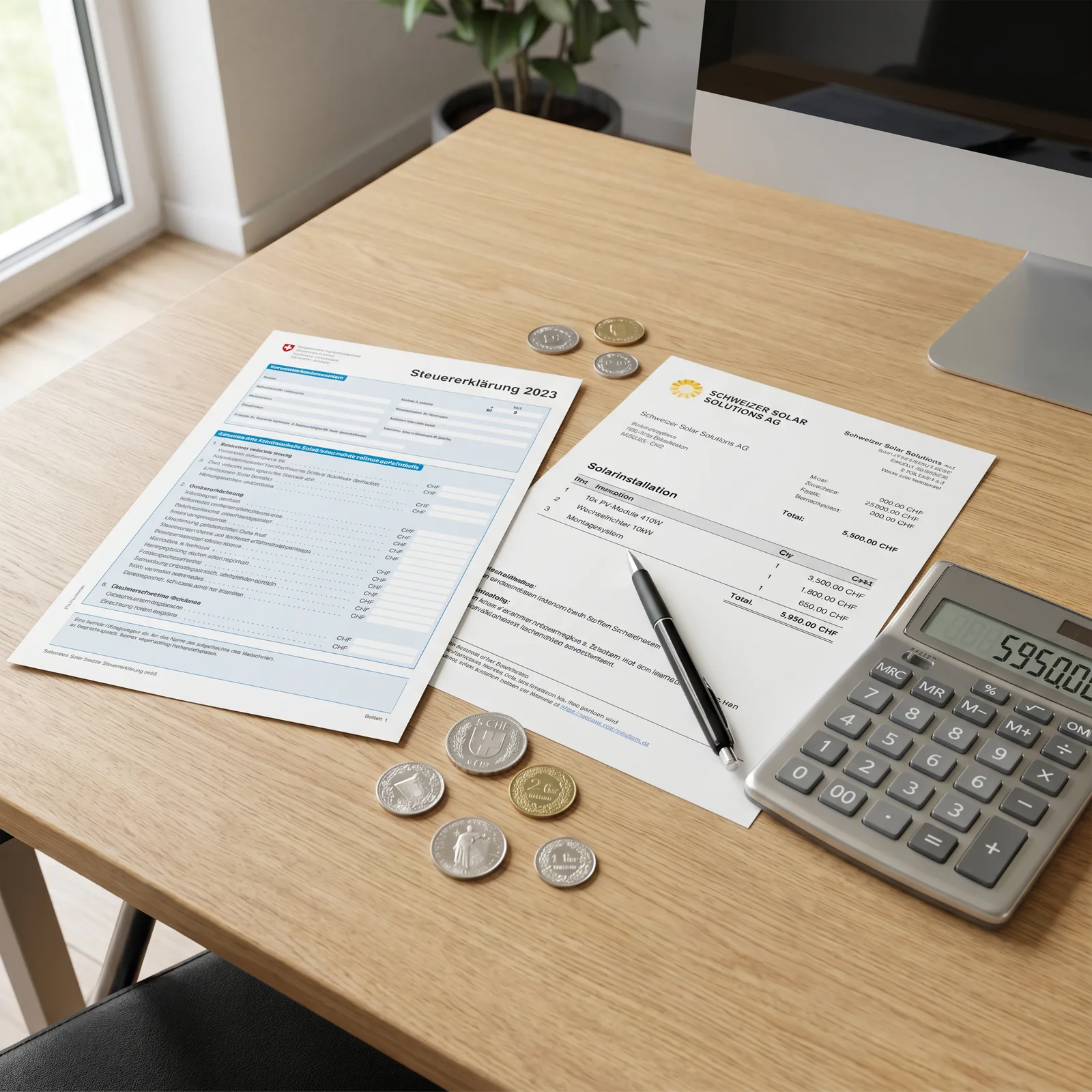
What does tax deductibility of a solar system mean?
In Switzerland, installing a solar system on an existing building is classified as property maintenance — that is, a value-preserving or value-enhancing measure. These costs can be deducted directly from taxable income, just like a roof renovation or a new heating system.
In concrete terms: if you invest CHF 20,000 in a solar system and your marginal tax rate is 30%, you effectively pay only CHF 14,000 — the state covers CHF 6,000 through the tax deduction.
Tax saving on investment
20–35%
Last chance for tax deduction
End of 2027
Typical tax saving
CHF 4,000–10,000
- The full installation costs of the solar system
- The battery storage system (in most cantons, if installed simultaneously)
- Planning costs and permit fees
- Future maintenance and servicing costs of the system (deductible annually)
- Inverter replacement after 10–15 years
Not deductible: systems on new buildings (in most cantons). Subsidies such as the OTP must be deducted from the deductible investment amount.
Why is 2026 the last big chance for the tax deduction?
On 28 September 2025, the Swiss electorate approved the abolition of the imputed rental value by 57.7%. This reform has direct consequences for all homeowners.
From 1 January 2028, at the federal level: the deduction for property maintenance disappears, along with the deduction for energy efficiency measures — and therefore also the tax deduction for new solar systems.
Some cantons may retain their own deduction options for energy-saving and environmental protection measures — but only until 2050 at most, and not all will do so. At the federal level, the advantage is definitively gone.
The consequence: anyone who installs a solar system before end of 2027 still benefits from the full federal tax deduction. Those who wait lose an advantage of CHF 4,000–10,000.
How much can you save? Calculation examples
The amount of tax saving depends on the investment amount, the canton and your personal marginal tax rate.
Example 1 — 10 kWp system, canton of Zurich, income CHF 120,000: Gross investment CHF 18,000 → Deduct OTP –CHF 3,550 → Deductible amount CHF 14,450 → Marginal rate ~30% → Tax saving approx. CHF 4,335 → Effective net investment CHF 10,115.
Example 2 — 15 kWp system, canton of Bern, income CHF 150,000: Gross investment CHF 26,000 → Deduct OTP –CHF 5,450 → Deductible amount CHF 20,550 → Marginal rate ~35% → Tax saving approx. CHF 7,193 → Effective net investment CHF 13,357.
Tax saving ex. 1 (ZH)
CHF 4,335
Tax saving ex. 2 (BE)
CHF 7,193
Net investment ex. 1
CHF 10,115
Net investment ex. 2
CHF 13,357
Tax tip: By making a partial payment in December and the remainder in January, you can spread the deduction across two tax years. This is particularly advantageous if the total investment would significantly reduce taxable income in a single year. Consult your tax adviser.
Solar panel tax deduction: cantonal comparison
The tax treatment of solar systems varies between cantons. Here is the current overview:
- Zurich: ✅ Investment deductible, ✅ Battery (simultaneous), ✅ Net principle — Additional subsidy City of Zurich
- Bern: ✅ Investment deductible, ✅ Battery (simultaneous), ✅ Net principle — Battery bonus up to CHF 800
- Aargau: ✅ Investment deductible, ✅ Battery (also retrofit), Gross principle — Battery also deductible as retrofit
- Lucerne: ✅ Investment deductible, ✅ Battery, ✅ Net principle — Tax-free allowance 10,000 kWh/year
- St. Gallen: ✅ Investment deductible, ✅ Battery (also retrofit), Net principle — Cantonal energy promotion
- Basel-Stadt: ✅ Investment deductible, ✅ Battery, ✅ Net principle — Additional municipal programmes
- Obwalden: ✅ Investment deductible, ✅ Battery, ✅ Net principle — Promotion on request
- Schwyz: ✅ Investment deductible, ✅ Battery (simultaneous), ✅ Net principle — Cantonal promotion
- Valais: ✅ Investment deductible, ✅ Battery (simultaneous), ✅ Net principle — Cantonal energy promotion
- Solothurn: ✅ Investment deductible, ❌ Battery not deductible, Gross principle
- Uri: ✅ Investment deductible, ❌ Battery not deductible, Gross principle
- Zug: ✅ Investment deductible, ❌ Battery not deductible, Net principle
Note: These figures are indicative values. Cantons may change their practice. Please consult your cantonal tax office or a tax adviser for your specific situation.
How does the tax deduction work in practice?
Step 1 — Make the investment: You commission a certified installer and pay for the system. Keep all invoices carefully.
Step 2 — Apply for subsidies: Your installer submits the OTP application to Pronovo. The OTP paid out must be deducted from the deductible investment amount.
Step 3 — Tax return: In the year of investment, you enter the deductible costs as property maintenance in your tax return. The OTP, if paid out in the same year, must be declared as income.
Step 4 — Annual maintenance costs: In subsequent years too, you can deduct maintenance costs, cleaning costs and any repairs as property maintenance.
What about battery storage?
The tax treatment of battery storage varies between cantons — but it is deductible in most of them.
- Battery installed together with the system: In cantons AG, BE, OW, SZ, ZH and VS, the battery is deductible if installed simultaneously with the PV system.
- Battery installed later: In cantons AG, BE, OW, SZ and SG, a battery retrofit is also tax-deductible.
- Battery not deductible: In cantons SO, UR and ZG, the battery storage system generally cannot be claimed.
Recommendation: Install the system and battery simultaneously — this maximises tax benefits and simplifies the declaration.
How is solar electricity production taxed?
Self-consumption: Solar electricity consumed by yourself is not taxed in Switzerland. What you produce and consume yourself is tax-free — another reason to maximise self-consumption.
Electricity fed into the grid (feed-in tariff): Electricity fed into the grid is taxed as income. Most cantons today apply the net principle — only what is actually paid out is taxed. For small systems with high self-consumption, this is often zero or a few hundred francs.
Subsidies (OTP): The one-time payment is considered income and must be declared in the year of payment. It also reduces the deductible investment amount.
Why you should act now — not in 2027
1. Planning takes time: From the first quote to commissioning a solar system takes 4–12 weeks. Anyone who wants to be installed before end of 2027 must order by autumn 2027 at the latest — and installers will be overloaded by then.
2. Costs rise under pressure: When everyone orders just before end of 2027, bottlenecks arise. Experience shows that prices and waiting times increase when many order simultaneously.
3. Every year without a system costs money: Investing now rather than in 2027 means saving electricity costs immediately. Two years of electricity savings at CHF 1,500/year is CHF 3,000 — money lost irrecoverably.
The most common reaction: 'I'll wait another year.' That sounds logical, but it is risky — installer capacities will be limited in the final months before end of 2027, and prices will rise under pressure.
Use the tax deduction while you still can — request a quote now
2026 and 2027 are the last years with full tax deduction at the federal level. Request up to 3 free quotes from certified installers in your canton now — and secure CHF 4,000–10,000 in tax savings.
Request a free quoteFrequently Asked Questions
Can I claim a solar system on my taxes in Switzerland?+
Yes. In almost all Swiss cantons, the investment costs of a solar system on an existing building can be deducted from taxable income as property maintenance. However, this advantage is only valid until end of 2027 at the federal level.
How much tax do I save with a solar system?+
Depending on the investment amount, canton and personal marginal tax rate, the tax saving is typically between CHF 4,000 and CHF 10,000. With a marginal rate of 30% and a net investment of CHF 15,000, that corresponds to CHF 4,500 in tax savings.
Until when can I claim a solar system for tax purposes?+
At the federal level, the tax deduction option is expected to expire at end of 2027 — as a result of the abolition of the imputed rental value approved on 28 September 2025. Some cantons may retain their own deduction options.
Can I spread the tax deduction across two years?+
Yes. By making a partial payment in December and the remainder in January, you can spread the investment across two tax years. This is often fiscally more advantageous if the total amount would significantly reduce taxable income in a single year.
Is battery storage also tax-deductible?+
In most cantons yes, especially if installed simultaneously with the solar system. In some cantons, a later retrofit is also deductible. Exceptions are SO, UR and ZG.
Do I have to pay tax on the one-time payment (OTP)?+
Yes, the OTP is considered income and must be declared in the year of payment. It also reduces the deductible investment amount. In practice: you deduct only the net investment (minus OTP) as property maintenance.
Does the tax deduction apply to new buildings?+
In most cantons not directly — new buildings are not considered property maintenance. The canton of Lucerne is an exception. For existing buildings (generally at least 5 years old), the deduction is possible in almost all cantons.
What happens to the tax deduction after 2028?+
At the federal level, the tax deduction for property maintenance is expected to disappear from 1 January 2028. Some cantons may maintain their own rules. Anyone who wants to benefit from the federal rule must be installed before end of 2027.