
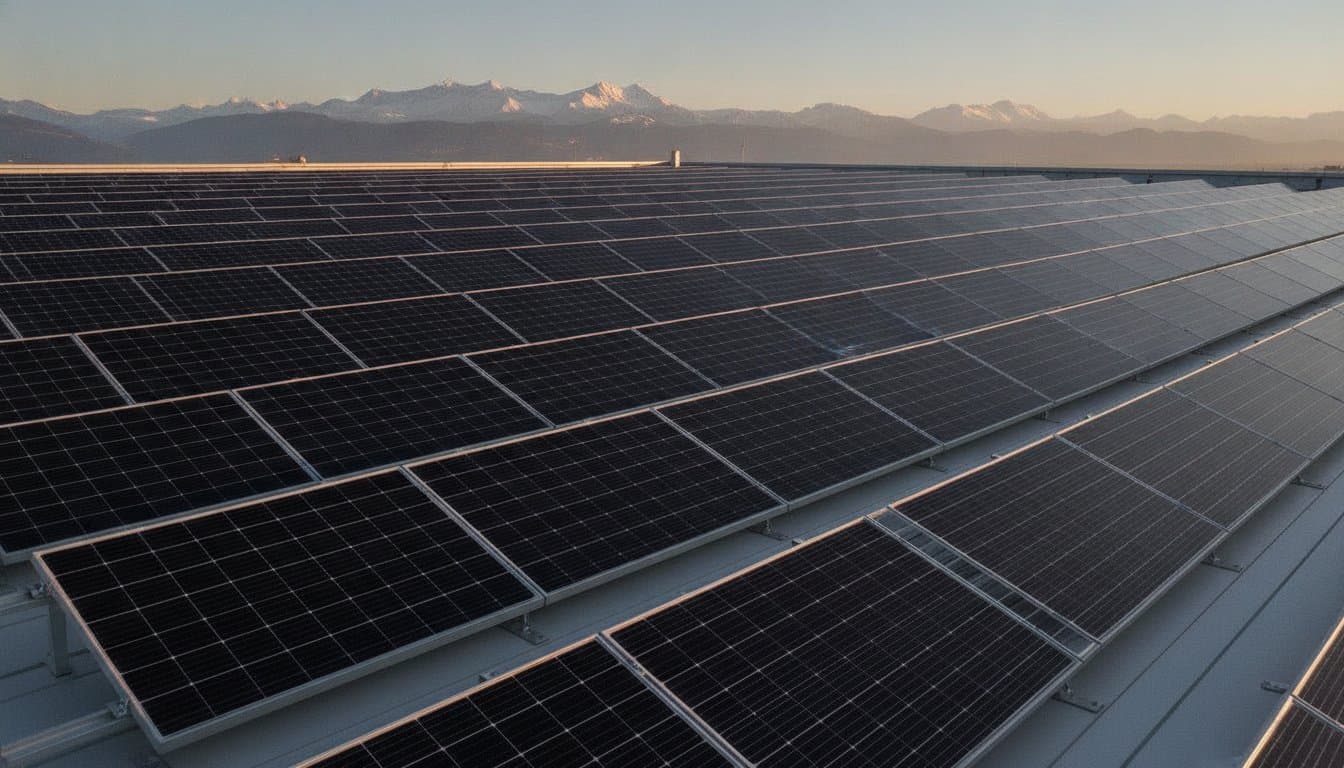
Why a Flat Roof is Ideal for Photovoltaics
A flat roof offers maximum flexibility in planning solar systems. Unlike a pitched roof, which is bound to a fixed orientation, a flat roof can be optimally adapted to a house's energy profile.
A technical advantage is the good rear ventilation of the modules, contributing to efficiency stability in summer. Additionally, accessibility eases maintenance and reduces operating costs.
- Consistent power production with east-west systems.
- Avoidance of shading breaks.
Mounting Systems and Structural Integrity: The Technical Basics
The choice of mounting system significantly affects your property's safety. Ballasted systems protect the roof surface and prevent roof penetrations, yet a professional structural calculation is necessary.
For older buildings, the roof's load-bearing reserve is crucial; the weight of the modules and systems must be supported by the roof structure. Wind loads are important factors to consider during planning.
- Ballasted systems protect the roof waterproofing.
- A professional structural assessment is essential.
Flat Roof Solar System Costs: These Investments You Should Expect
In 2026, the costs for solar systems have stabilized. The main cost points are modules, inverters, substructure, and installation.
Larger systems benefit from economies of scale, significantly reducing the cost per kWp.
- Subsidies significantly reduce net costs.
Permits and Subsidies in Switzerland
In Switzerland, solar systems are supported by government grants and tax benefits, significantly lowering costs.
The notification procedure is simple, and a construction permit is usually not required. New regulations since 2026 offer a guaranteed minimum remuneration for fed-in electricity.
- One-time remuneration (OIE) from Pronovo lowers investment costs.
- Tax deductibility offers additional savings.
Frequently Asked Questions
Do I need a building permit for a flat roof solar system?+
In most cantons, a regular building permit is not required. A simple notification procedure is sufficient if the building is not a historic monument.
How much ballast is needed for a flat roof solar system?+
The amount of ballast depends on building height and wind protection zone. Typically, it ranges from 20-50 kg/m². A static calculation is essential.
Is a solar system on a flat roof more expensive than on a tiled roof?+
Yes, flat roofs require more complex substructures, increasing the cost. However, the easier accessibility can compensate for this.
Can solar modules be installed on a flat roof without drilling?+
Yes, ballasted mounting systems allow for installation without penetrating the roof surface, preserving the roof waterproofing.
PvPro.ch
Solar guides
Information from PvPro.ch about solar installations, costs, subsidies and comparing quotes in Switzerland.
About PvPro.ch →Indicative values, updated September 2026. Sources: Pronovo, ElCom, Swissolar.
Your Next Steps to Your Own Solar System
Take advantage of our free and non-binding service now to bring clarity to your planning process. The path to your own clean electricity has never been so safe and easy.
Compare free solar quotes now