
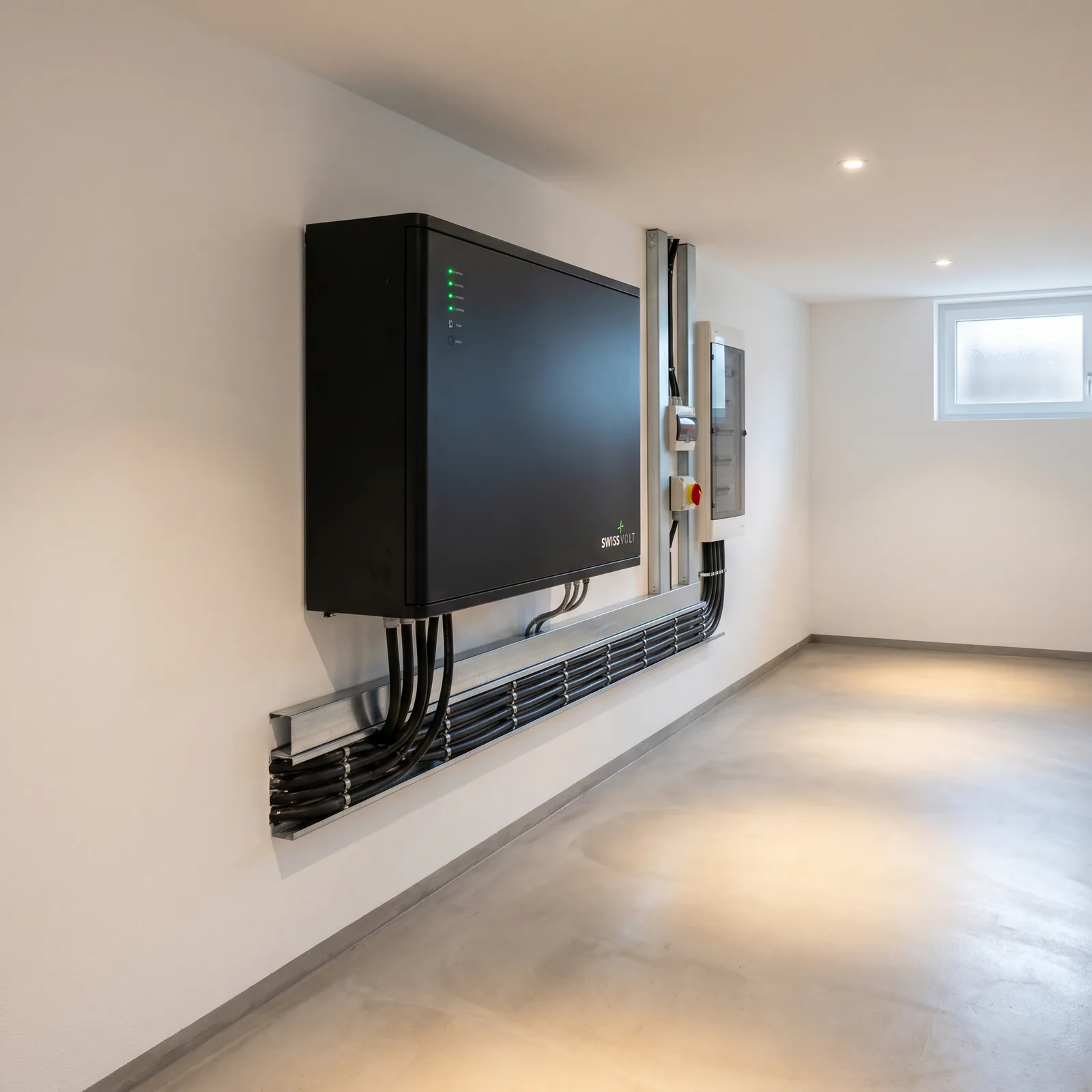
How does a home battery work?
A home battery stores surplus solar electricity produced during the day that is not immediately consumed. At night or on cloudy days, this stored electricity is used instead of buying expensive grid power.
Without storage, surplus is fed into the grid (payment: approx. CHF 0.08–0.14/kWh). With storage, you use it yourself (value: CHF 0.28–0.34/kWh) – the difference is enormous.
Self-consumption without battery
25–35%
Self-consumption with battery
60–80%
Battery cost
CHF 5,000–12,000
Payback
9–12 years
Costs and capacities in 2026
Battery prices have fallen significantly in recent years. A good 10 kWh battery costs CHF 6,000–9,000 in 2026; a 15 kWh system CHF 9,000–14,000.
The ideal battery size depends on your system and consumption. Rule of thumb: 1 kWh of storage per 1 kWp of installed capacity is a good starting point.
- 5 kWh battery: approx. CHF 4,000–6,000
- 10 kWh battery: approx. CHF 6,000–9,000
- 15 kWh battery: approx. CHF 9,000–14,000
- Lifespan: 10–15 years, 3,000–6,000 charge cycles
Who benefits most from a home battery?
A home battery is especially profitable for households with high evening consumption, a heat pump or an electric vehicle. Self-consumption can rise to 70–85% and the payback period can fall to 7–9 years.
- Household with heat pump: very profitable
- EV owner: night-time charging with own solar
- High evening consumption: battery optimal
- Businesses with consumption outside solar hours
With an electric vehicle and a heat pump, the battery payback period drops to 7–9 years.
Tax treatment and subsidies for batteries
Good news: in all Swiss cantons, the battery is also tax-deductible as part of the solar installation. Some cantons such as Bern, Lucerne and Aargau pay additional cantonal contributions specifically for storage.
- All cantons: battery deductible as property maintenance
- Bern: separate battery bonus up to CHF 800
- Lucerne: battery contribution up to CHF 600
- Combination with heat pump often additionally subsidised
Solar system with battery – get a quote now
Our partner installers will size the ideal battery for your household. Free analysis and quote within a few days.
Request a free quoteFrequently Asked Questions
How large should my home battery be?+
Rule of thumb: 1 kWh of storage per 1 kWp of system capacity. For an 8 kWp system, 8–10 kWh is ideal. With an EV or heat pump, you can go higher.
How long does a home battery last?+
Modern lithium-ion batteries last 10–15 years or 3,000–6,000 charge cycles. Manufacturers typically provide 10-year guarantees. After its lifespan, the battery can often be replaced at lower cost.
Are there subsidies for batteries in Switzerland?+
Yes. Batteries are tax-deductible in all cantons. Some cantons like Bern, Lucerne and Aargau pay additional cantonal contributions. The EIV often includes the battery too.
Can I add a battery retrospectively?+
Yes, in most cases a retrofit is possible. Modern inverters often already have a storage interface. The effort is slightly higher, but technically straightforward.