
The facts: how high is the fire risk really?
The answer comes from a study by the renowned RWTH Aachen University from December 2024 — one of the largest investigations ever conducted into the safety of home storage systems.
Fire risk for home storage systems: 0.005% per year. This means: out of 100'000 installed battery storage systems, statistically only one catches fire per year.
For comparison: General house fire risk approx. 0.25% — Dishwasher approx. 0.03% — Washing machine approx. 0.025% — Battery storage (LFP) approx. 0.005% — Candles approx. 0.5%.
A modern LFP battery storage system is therefore 50 times safer than the general house fire risk — and safer than your washing machine.
fire risk according to RWTH study 2024
0.005%
than the general house fire risk
50x safer
of storage systems in CH are LFP — the safest technology
80%
Why do some batteries have a bad reputation?
Reports of burning batteries almost exclusively concern NMC batteries (nickel-manganese-cobalt) — an older technology used in early home storage systems and especially in electric cars and smartphones.
NMC batteries are chemically less stable when overheated, can catch fire due to overcharging or mechanical damage, and release oxygen during thermal runaway — which fans the flames. They are barely used in new home storage systems.
LFP batteries (lithium iron phosphate) are chemically extremely stable, even when overheated. They show no thermal runaway under normal conditions and do not release oxygen in the event of damage. They are now standard in Switzerland: over 80% of all newly installed systems use LFP technology.
Conclusion: if you buy a new battery storage system today, you will in all likelihood get an LFP battery — the safest technology available for home storage systems.
What is LFP and why is it so safe?
LFP stands for Lithium Iron Phosphate (LiFePO₄). This cell chemistry has decisive advantages over older lithium technologies.
Thermal stability: LFP cells only begin to decompose at over 270°C — NMC cells already from 150°C. Even in the event of a house fire, thermal runaway would not be expected.
No oxygen when overheated: Other lithium technologies can release oxygen when overheated, intensifying the fire. LFP does not do this — the fire cannot fuel itself.
Mechanical robustness: LFP cells withstand even strong mechanical loads. The famous "nail test" — a nail driven into the battery — causes no fire reaction in LFP batteries.
Lifespan: LFP batteries last 4'000–8'000 charge cycles — corresponding to 15–25 years with daily charging. They thus significantly outperform NMC batteries.
Well-known manufacturers using LFP technology: BYD (HVM/HVS), Huawei (Luna), Fronius (Reserva), Fenecon (Home) — all market leaders now rely on LFP.
Where may I install a battery storage system?
Installation location is crucial for safety. In Switzerland, the following applies:
Ideal ambient temperature: 5–35°C (LFP loses a little performance in cold, but remains safe). No direct sunlight. Sufficient ventilation. Minimum distance from flammable materials according to manufacturer instructions. Do not install in escape routes.
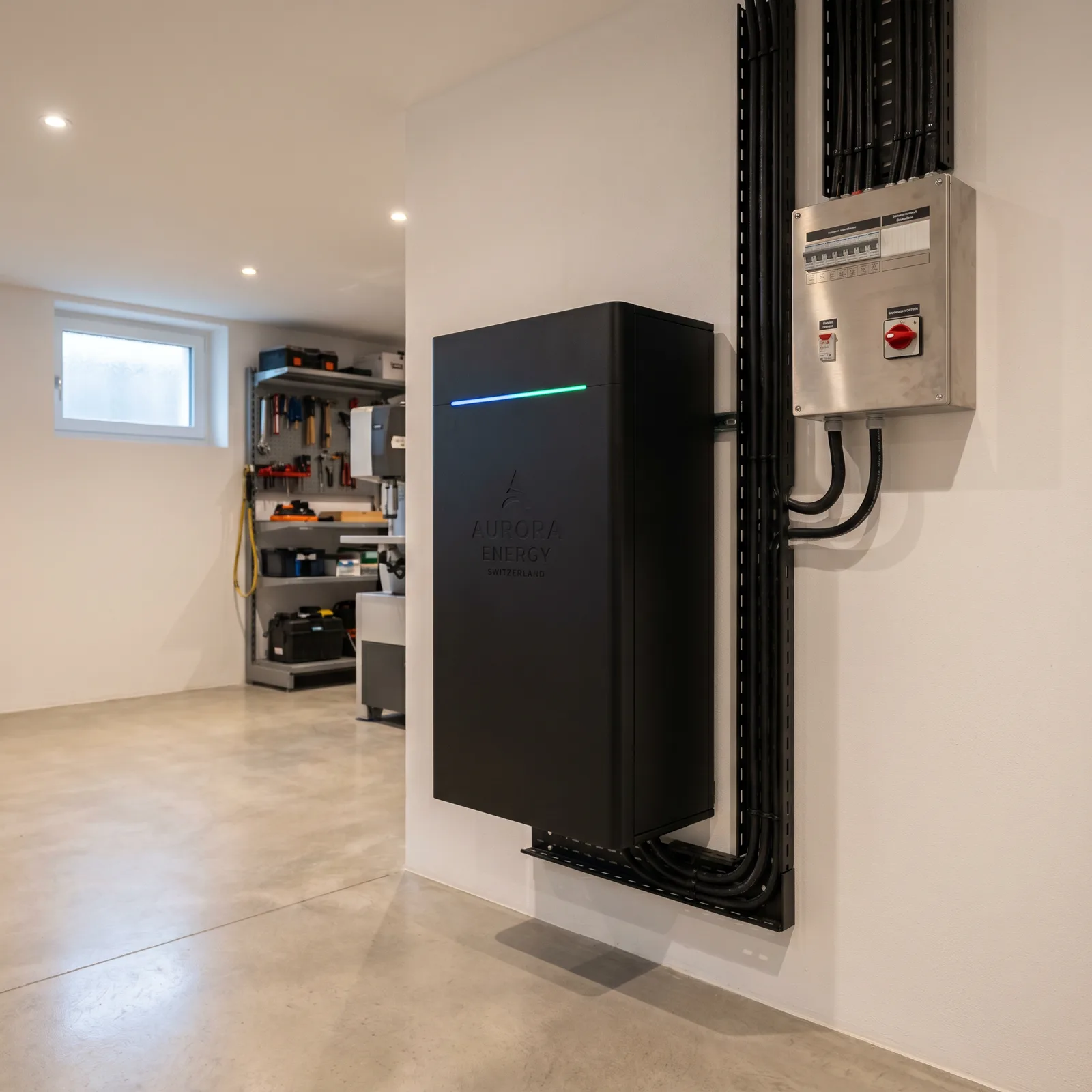
- Basement (dry, ventilated) ✅
- Utility room ✅
- Garage (with a suitable system) ✅
- Technical room ✅
- Escape routes — prohibited ❌
- Direct sunlight — avoid ❌
According to the VKF (Association of Cantonal Fire Insurance Authorities), LFP battery storage systems may be installed in all rooms — without special fire protection requirements beyond the manufacturer instructions.
What safety standards should a storage system have?
When purchasing a battery storage system, look for the following certifications:
IEC 62619 — International safety requirements for stationary lithium batteries.
VDE-AR-E 2510-50 — German standard for home storage systems — recognised in Switzerland.
CE marking — Compliance with European safety standards.
UN 38.3 — Transport tests for lithium batteries.
A reputable installer in Switzerland only installs systems with these certifications. Ask explicitly for them before signing.
What is the battery management system (BMS) and why is it important?
Every modern battery storage system has a battery management system (BMS) — the electronic protection layer that prevents the battery from reaching dangerous states.
The BMS monitors in real time: the temperature of each individual cell, the state of charge and depth of discharge, the current flow and voltage, and cell balancing (charging/discharging all cells evenly).
If deviations occur, the BMS immediately intervenes and interrupts the current flow. It is the most important safety component — and a quality feature that cheap no-name products often do not implement correctly.
Recommendation: Only buy storage systems from well-known manufacturers with a proven BMS — even if the price is slightly higher.
What about Chinese batteries — are they safe?
Many Swiss homeowners ask this question, as Chinese manufacturers such as BYD and Huawei dominate the Swiss market and account for approximately two thirds of all installed systems.
The honest answer: Yes, the leading Chinese manufacturers are safe — if you choose the right ones. BYD and Huawei are global leaders in LFP technology and meet all relevant international safety standards (IEC 62619, CE, UN 38.3). Their products are regularly tested by independent institutes.
The difference lies with no-name products from the low-price segment — there, quality control can be deficient. These should be avoided.
Our recommendation: Buy branded products from well-known manufacturers — whether Chinese or European matters less. More important are the certification and the guarantee.
Checklist: what to look out for when buying
Before buying a battery storage system, check these points:
- ✅ LFP technology — ask explicitly about the cell chemistry
- ✅ IEC 62619 certification — international safety standard
- ✅ CE marking — European standard
- ✅ Proven BMS — from a brand manufacturer
- ✅ At least 10 years warranty — on capacity and function
- ✅ Certified installer — electrical installation only by a specialist
- ✅ Correct installation location — according to manufacturer instructions and VKF guidelines
- ✅ Check fire insurance — whether your building insurance covers storage systems
What does Swiss insurance say about this?
An important practical point: is your battery storage system covered by building insurance?
In most Swiss cantons, the battery storage system is automatically covered by building insurance as a permanent part of the property — just like a heating system or an inverter.
Nevertheless, check the following: Inform your building insurance about the installation. Clarify whether damage caused by short circuits or malfunctions is covered. For rental properties: check the landlord's policy.
A reputable local installer will answer these questions — they know the practices in your canton.
Find a safe battery storage system in your canton
PVPro.ch only brokers certified installers who exclusively install verified LFP systems with recognised safety certifications. Get up to 3 quotes for free — and invest safely.
Request a free quoteFrequently Asked Questions
Is a battery storage system for a solar installation dangerous?+
Modern LFP battery storage systems are very safe. According to an RWTH study from 2024, the fire risk is only 0.005% per year — 50 times lower than the general house fire risk. The LFP technology, which is now standard in Switzerland, is thermally extremely stable and practically non-flammable.
Can a battery storage system explode?+
Explosions in modern LFP home storage systems are virtually impossible. The chemistry of LFP cells is so stable that even mechanical damage does not trigger a chain reaction. Older NMC technologies have a higher risk — but they are barely used in new home storage systems.
Where may I install a battery storage system?+
LFP battery storage systems may be installed in all rooms — basement, utility room, garage. Important: dry location, ambient temperature 5–35°C, sufficient ventilation and minimum distances from flammable materials according to manufacturer instructions.
Are Chinese battery storage systems safe?+
The leading Chinese manufacturers such as BYD and Huawei produce high-quality LFP storage systems that meet all international safety standards. No-name products from the low-price segment without recognised certifications should be avoided.
How long does a battery storage system last?+
Modern LFP battery storage systems last 4'000–8'000 charge cycles, corresponding to 15–25 years with daily charging. Most manufacturers offer 10 years' warranty on at least 80% of the original capacity.
Do I need to report my battery storage system to my insurance?+
Yes, recommended. In most Swiss cantons, the storage system is automatically covered by building insurance as a building component. Nevertheless, report the installation to ensure that damage is covered.
What certifications should a safe battery storage system have?+
At minimum IEC 62619 (international standard for stationary lithium batteries), CE marking and UN 38.3. For the Swiss market, VDE-AR-E 2510-50 is also a recognised quality feature.